Maintenance & Support
Gas Blending Reference
Formulas and references for qualified gas blenders. EANx, Trimix, partial pressure blending, transfilling, and more. All DTTFF team members are qualified gas blenders.
Dalton's Law
Partial Pressure Triangle
Partial pressure (PP), gas fraction (G), and depth (D) are related. Know any two and you can calculate the third. Depth is always expressed in ata; gas fraction always as a decimal (e.g. O₂ in EANx32 = 0.32).
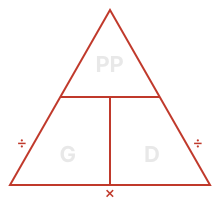
PP Partial pressure (e.g. PPO₂ 1.6)G Gas fraction as a decimalD Depth in ata (1 ata = surface)Example: PPO₂ for EANx32 at 27m (3.7 ata) = 0.32 \times 3.7 = \mathbf{1.18}
Trimix
Equivalent Narcotic Depth (END)
Calculates the equivalent air depth in terms of narcotic load. O₂ and N₂ are both considered narcotic. He is not. Depth in ata; narcotic gas fraction as a decimal.
f narcotic = O₂% + N₂% (i.e. 1 - f_{He})Example: 18/45 Trimix at 60m (7 ata). Narcotic fraction = 1 - 0.45 = 0.55
END = 7 \times 0.55 = 3.85 \text{ ata} = \mathbf{28.5\text{m}}
EANx Blending
Continuous Flow Top-Up
Use this when topping up a partially filled cylinder and you want to hit a different final mix. Calculates the O₂% of the top-up gas required.
SP Starting pressureEP Ending pressureSO2 Starting O₂%EO2 Ending O₂%SPO2 SP \times SO_2EPO2 EP \times EO_2Example: 50 Bar of EANx32, filling to 200 Bar, target EANx36.
EPO_2 = 200 \times 0.36 = 72 | SPO_2 = 50 \times 0.32 = 16
\frac{72 - 16}{200 - 50} = \frac{56}{150} = 0.37 = \mathbf{EANx37}
EANx Blending
Partial Pressure EANx Blending
For blending EANx using 100% oxygen topped up with air into an empty cylinder. Gives the pressure of oxygen to add first.
Example: EANx36 to 200 Bar.
\frac{0.36 - 0.21}{0.79} \times 200 = \mathbf{38 \text{ Bar } O_2}, then top to 200 Bar with air.
Trimix Blending
Trimix Blending Calculations
Follow steps 1 and 2 when using EANx as a top-up gas. Add step 3 if topping up with air instead (converts the EANx mix to an oxygen fill pressure).
Example: Target 21/20 Trimix to 200 Bar.
P_{He} = 0.20 \times 200 = 40 \text{ Bar} | EANx_{\text{top-up}} = \frac{0.21}{1 - 0.20} = EANx26
If using air: \frac{0.26 - 0.21}{0.79} \times (200 - 40) = \mathbf{10 \text{ Bar } O_2}, then 40 Bar He, top to 200 Bar with air.
Transfilling
Transfilling / Decanting Pressure Drop
Determines whether your bank cylinder has enough pressure to decant without a booster pump. If BP2 > required fill pressure, no booster is needed.
BP1 Bank starting pressureBP2 Bank ending pressureBV Bank water volume (L)RP1 Recipient starting pressureRP2 Recipient ending pressureRV Recipient water volume (L)Empty recipient:
Recipient with residual pressure:
Example: 50 L He bank at 72 Bar, decanting 40 Bar into empty 22 L twin set.
BP2 = \frac{(72 \times 50) - (40 \times 22)}{50} = \frac{2720}{50} = \mathbf{54.4 \text{ Bar}}
BP2 (54.4) > RP2 (40) — no booster needed.